
India’s top two listed discount brokers have reported their Q1FY27 results.
But the real story isn’t about brokering anymore. Both are slowly transforming into full-stack financial platforms with lending, asset management, wealth management, insurance, and more.
Let’s decode.
Why are brokers diversifying?
During the post-COVID bull market, F&O trading exploded.
Retail participation surged, volumes hit record highs, and brokers saw their profits grow rapidly as derivatives became their biggest revenue driver.
But rising losses among retail traders pushed SEBI to tighten regulations. On November 2024, SEBI introduced three major changes:
-Only one weekly index expiry per exchange, reducing expiry-day speculation.
-Minimum contract size increased to ₹15–20 lakh from around ₹5–10 lakh, increasing the capital required for trading.
-Additional 2% Extreme Loss Margin (ELM) on short options on expiry day to reduce excessive risk.
These changes significantly impacted F&O trading volumes across the industry.
For brokers, this became a wake-up call. Relying heavily on one business segment was no longer sustainable.
Both Angel One and Groww have been aggressively building new businesses.
Broking is now just one part of the business. Today’s revenue mix includes:
-Equity Derivatives: Trading futures and options on stocks and indices.
-Cash Market: Buying and selling shares with actual ownership.
-Commodity Derivatives: Trading gold, silver, crude oil, and other commodities.
-Float Income: Interest earned on idle customer cash balances.
-MTF (Margin Trading Facility): Lending money to clients to buy stocks and earning interest.
-Credit: Personal loans and loans against securities.
-AMC: Managing mutual funds and earning management fees.
-Wealth Management: Investment advisory and portfolio management for affluent customers.
The strategy is simple.
Increase revenue from businesses that generate recurring income instead of depending only on trading activity.
Angel One: Diversification is already showing up

Angel One reported a strong quarter.
-Revenue grew 25.4% YoY
-Profit jumped 102.1% YoY
Margins improved sharply. The biggest growth came from businesses outside traditional broking.
Wealth Management AUM increased 33% QoQ
Asset Management AUM increased 70% QoQ
Today, nearly 40% of Angel One’s revenue comes from interest income and distribution businesses, including MTF, lending, float income, and other financial products.
Only around 60% comes from equity, commodity derivatives, and cash broking.
The company is also entering insurance through its JV with LivWell Holdings, adding another layer to its financial ecosystem.
Groww: Building beyond broking
Groww also reported an impressive quarter.
-Revenue grew 66% YoY
-PAT increased 94% YoY
But again, the bigger story is diversification.
Its AMC business is scaling rapidly. AMC AUM grew around 140% YoY. The partnership with State Street Global Advisors brings global expertise that could accelerate its mutual fund business over the coming years.
On the wealth side, Groww has acquired Fisdom, through which it distributes Regular Mutual Funds, PMS, AIFs, Insurance, and Unlisted Securities
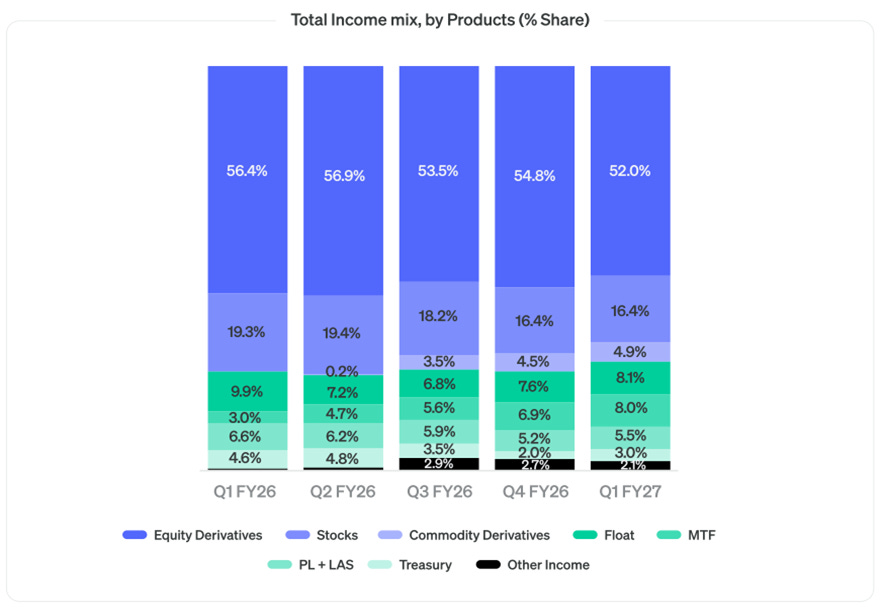
Management has clearly stated that its long-term goal is to bring broking revenue below 50% of overall revenue. The lending business is also expanding rapidly. MTF book grew 264.4% YoY. Commodity trading is becoming another meaningful growth engine, contributing ~5% to the top line. In Q1FY26, equity derivatives contributed 56.4% of revenue. Today, that has declined to 52%, while commodity derivatives, which previously had almost no contribution, now account for 4.9%.
The revenue mix is gradually becoming more balanced. The days when brokers were simply execution platforms are ending.
Our view on this:
Both Angel One and Groww are building integrated financial ecosystems where one customer can trade, invest, borrow, buy insurance, and manage wealth from a single platform.
This also makes the business more predictable. Trading volumes can fluctuate every quarter. The next phase of growth for brokers won’t come from higher F&O volumes alone. It will come from building a complete financial ecosystem. Lending, asset management, wealth management, insurance, and credit businesses offer more stable, recurring revenue, making these companies far less dependent on market cycles over time.
Disclaimer — This article is for information purposes only and should not be considered investment advice or a recommendation to buy or sell any security. Please conduct your own research or consult a qualified financial advisor before making any investment decision. Reco Wealth is a SEBI-registered Research Analyst.